You open your grinder and see that fine, golden layer settled in the chamber. It looks small, but any experienced smoker knows it isn't throwaway dust. It's kief. It holds a dense share of the cannabinoids and terpenes that make a good flower session feel flavorful, aromatic, and effective.
That's why careless storage hurts twice. You don't just lose material. You lose the best part of it.
People searching for how to store kief usually want a simple answer, but the best answer depends on how fast you'll use it, how much you've collected, and whether you're protecting a little grinder stash or a serious haul from premium flower. The good news is that the rules are straightforward once you understand what's damaging it.
Protecting the Gold Standard of Cannabis
Kief deserves better than being forgotten in a grinder for months.
If you've collected it from well-grown flower, you already know it can enhance a bowl, enrich a joint, or become the starting point for hash. It's one of the most concentrated, delicate forms of cannabis many people handle at home. Treating it like loose scrap is the fastest way to flatten its aroma and dull its punch.
Why kief needs extra care
Kief is exposed in a way whole flower isn't. Once those trichomes are separated, they're more vulnerable to air, heat, light, and moisture. That means the storage question isn't just about keeping it “good enough.” It's about preserving what made it worth collecting in the first place.
A lot of customers understand strains, but not enough connect strain quality to post-purchase care. If you want a better read on how cultivar choice shapes aroma, effects, and resin production, this guide on understanding the different strains of cannabis is a smart companion piece.
Kief rewards careful handling more than almost any other everyday cannabis format.
The practical mission
Good storage comes down to protecting the compounds you care about. That means preserving scent, texture, and potency without making daily use annoying. In practice, that usually means a container that seals tightly, blocks or avoids light, and lives somewhere stable instead of somewhere convenient but risky.
Think drawer, cabinet, stash box, or shelf in a climate-controlled room.
Not windowsill. Not bathroom cabinet. Not next to the stove.
If you start with premium flower from brands known for resin-rich cultivation, the gap between proper and sloppy storage becomes obvious fast. Well-kept kief stays expressive longer. Poorly stored kief gets dull, clumpy, and lifeless.
Kief Storage Fundamentals The Four Enemies of Freshness
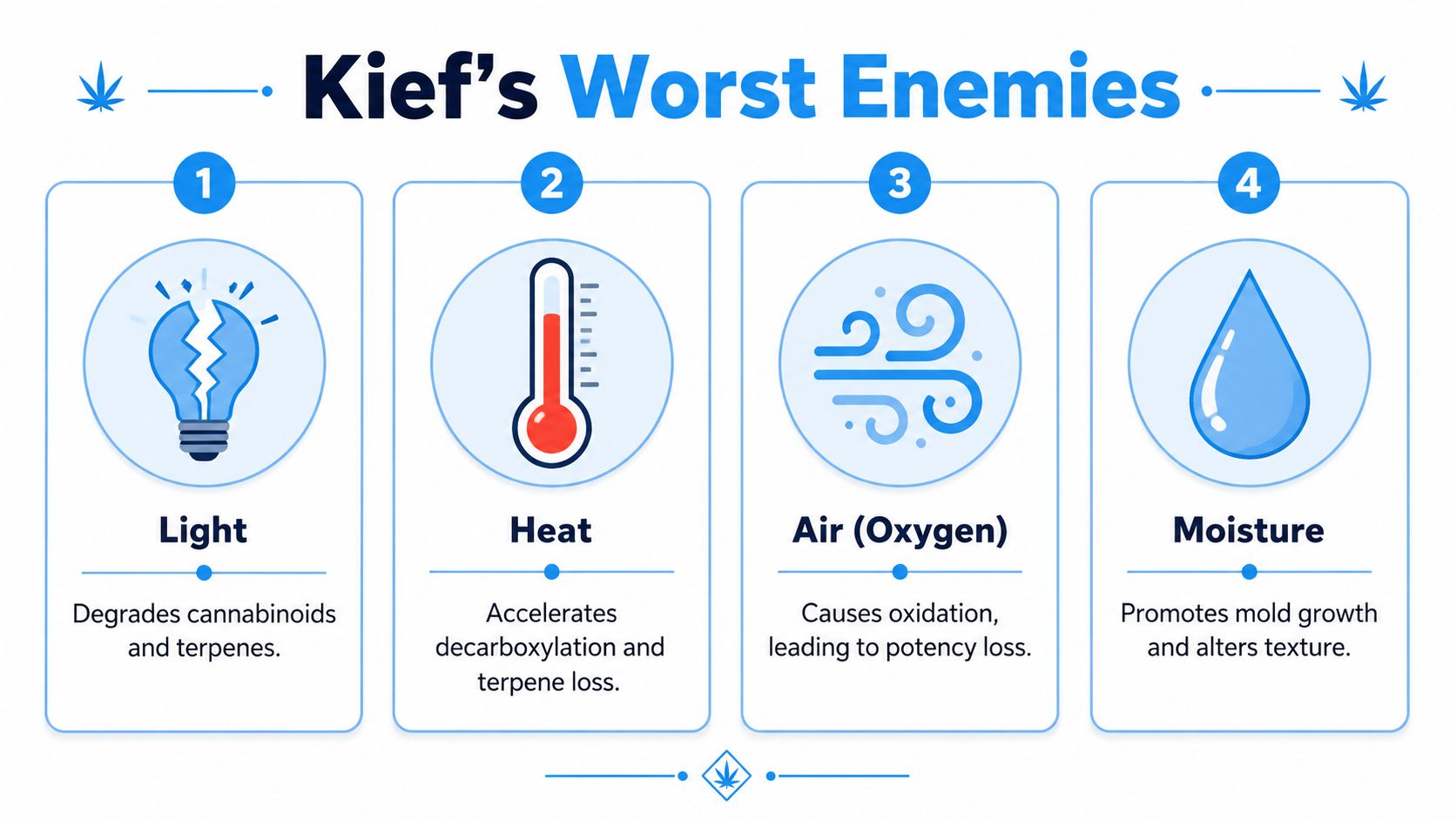
The science is simple. Kief lasts longer when you reduce exposure to oxygen, light, heat, and moisture. One storage guide recommends a band of 32°F to 68°F (0°C to 20°C), while another says to keep kief below 77°F in darkness. Humidity guidance is also tight, with recommendations ranging from 55% to 63% RH to avoid mold and excessive drying, according to Sorting Robotics on storing and handling kief.
Light strips away quality
Direct light is bad. Repeated indirect light isn't great either.
Kief contains compounds that degrade when they're exposed over time, especially if you leave it in a clear container on a shelf. A clear jar can still work, but only if that jar stays in darkness when it's not in use. If your jar lives out in the open, you're slowly cooking off part of what makes it enjoyable.
Heat speeds everything up
Heat doesn't need to be extreme to be a problem. Warm rooms, sunny corners, a shelf above electronics, or a cabinet near the oven all push degradation faster than is often understood.
That's why stable storage matters more than a clever stash spot. The same logic shows up outside cannabis too. If you've ever read about secure wine storage with MG Self Storage, the overlap is obvious. Fine products keep their character longer when temperature and light stay controlled.
Practical rule: If the spot gets warm, steamy, or bright during any part of the day, it isn't a good home for kief.
Air and moisture create different problems
Oxygen and humidity don't ruin kief in the same way.
Air exposure drives oxidation. Every time you leave a jar partly empty or open it longer than needed, you increase that exposure. Moisture is a separate threat. Too much can encourage mold and clumping. Too little can leave kief brittle and less aromatic.
A tight seal and a stable room do most of the heavy lifting. Fancy storage fails if the environment around it is constantly shifting.
- Light exposure: Better hidden than displayed.
- Warm storage: Better in a cool drawer than near kitchen heat.
- Too much air in the container: Better in a small jar than a half-empty large one.
- Humidity swings: Better in a dry, stable room than anywhere near a bathroom.
Your Everyday Kief Stash Short-Term Solutions
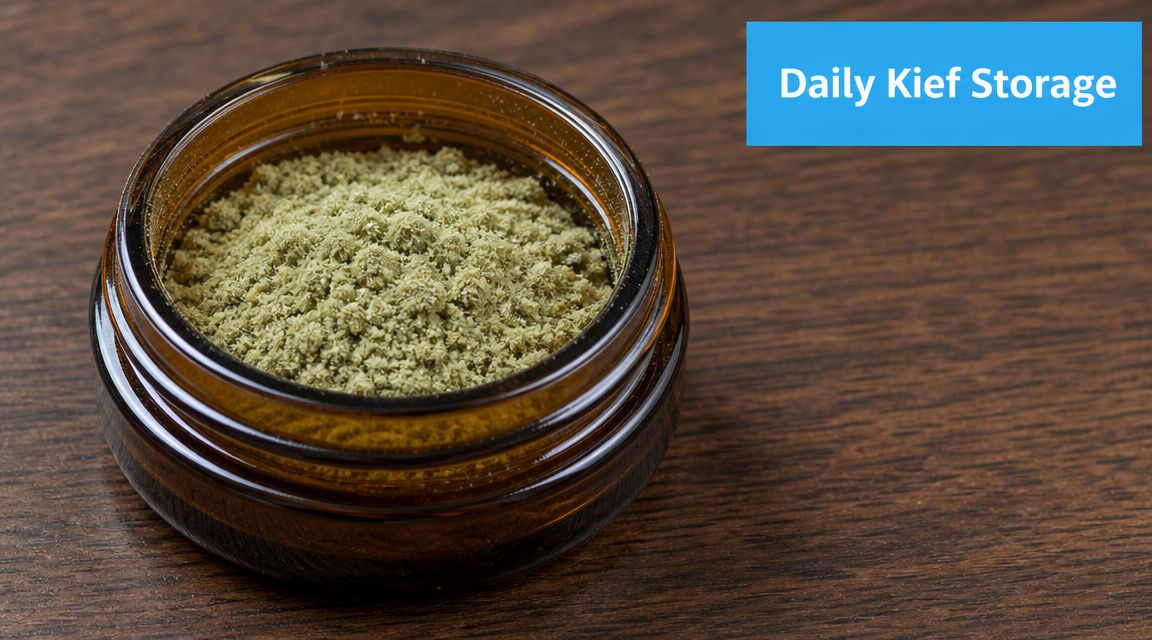
For kief you'll use regularly, the best setup is simple. Transfer it into a small airtight glass jar and keep it in a cool, dark place around 60–70°F (15–21°C). One of the most common mistakes is using an oversized container, which leaves extra air inside and speeds oxidation. Stored properly, kief can remain usable for many months, as noted in Hurcann's kief storage guidance.
Pick the right jar, not just any jar
For day-to-day use, glass wins.
It's easy to clean, doesn't hold static the way cheap plastic can, and usually seals better. Amber glass is nice if you have it, but plain glass works fine when it stays in a drawer or cabinet. The key is matching the jar size to the amount of kief you have.
If you've got a thin layer in the bottom of a huge jar, you've built an oxygen chamber around it.
A small grinder with a dedicated kief chamber is a good collection tool, but it shouldn't be the final storage tool for anything you want to preserve. Once you've built up enough to keep, transfer it out.
A daily-use routine that works
Short-term storage should feel easy enough that you'll stick with it.
- Use a clean transfer tool: Metal or silicone works well for moving kief without adding skin oils.
- Fill a small jar: Leave as little empty space as practical.
- Store it somewhere boring: A bedroom drawer or dry cabinet beats a kitchen shelf every time.
- Open it briefly: Get what you need, reseal it, put it back.
That's the everyday version of how to store kief without overcomplicating it.
If you want a quick visual walkthrough before setting up your own stash system, this video is a useful primer.
What works and what doesn't
Some setups sound fine until you think about the environment.
Works well
- Small airtight glass jar: Best mix of protection and convenience.
- Opaque stash box or dark drawer: Good for keeping light off the jar.
- Stable indoor room: Better than any room with steam or cooking heat.
Usually fails
- Leaving kief in the grinder too long: Too much air exposure over time.
- Kitchen storage: Heat shifts all day.
- Bathroom cabinet: Humidity swings make it a poor fit.
- Large container for a small amount: Too much headspace.
Preserving Your Haul Long-Term Storage Techniques
Long-term storage is different from daily storage. Convenience matters less. Protection matters more.
If you've built a meaningful stash and want to preserve it for the long haul, expert guidance favors freezing portioned, airtight containers. The most important rule is to avoid repeated thaw and refreeze cycles because those temperature swings create condensation that can damage trichomes. To prevent that, let the container return to room temperature before opening it. One industry source also notes that improper storage can lead to cannabis losing about 16–20% of its THC in the first year, according to Sorting Robotics on long-term kief storage.
Freezing only makes sense when you do it properly
Freezing isn't the best answer for everyone. It's the best answer for people who want to preserve kief for a long time and can stay disciplined about portioning.
If you freeze one bulk jar and keep dipping into it, you've turned a preservation method into a damage cycle. Every warmup and cool-down adds risk. Every opening adds more opportunity for moisture to get involved.
Freeze once, in portions you can actually use, and thaw only what you plan to open.
The safer workflow
Here's the version that holds up in practice:
- Portion the kief first. Divide it into small amounts so you won't need to reopen the main supply repeatedly.
- Use airtight containers. Small glass containers are the most dependable option for most home users.
- Keep moisture out. Don't freeze anything loosely sealed.
- Warm before opening. Let the sealed container come to room temperature first.
- Don't refreeze opened portions. Use them as your active stash instead.
That last point matters. A portioned system protects the untouched reserve.
Kief Storage At-a-Glance
| Attribute | Short-Term Storage (Days/Weeks) | Long-Term Storage (Months/Years) |
|---|---|---|
| Best container | Small airtight glass jar | Portioned airtight containers |
| Main priority | Easy access with low exposure | Maximum preservation |
| Best location | Cool, dark, dry drawer or cabinet | Freezer, only when sealed correctly |
| Biggest risk | Oversized jar with too much air | Condensation from poor thawing |
| Access pattern | Open as needed, briefly | Open only after warming to room temperature |
| Best for | Frequent personal use | Bulk reserves or archived stash |
When not to freeze
If you use your kief every few days, freezing may be more trouble than benefit. A well-kept cupboard setup is often the better practical choice for active stash. Freezing shines when you have a reserve you won't touch often.
That's the trade-off. Cold storage can protect a stash longer, but only if your handling is disciplined.
Common Kief Storage Mistakes and Pro Handling Tips
The refrigerator gets suggested all the time. It sounds logical and usually isn't.
Expert guidance advises against refrigeration for kief because of severe humidity cycling. For long-term preservation, freezing is the better option, but only in vacuum-sealed or completely airtight containers, and only when you let the container reach room temperature before opening it, according to Mood's guide to storing kief.
The mistakes that cost people quality
Most kief loss comes from ordinary habits, not dramatic mistakes.
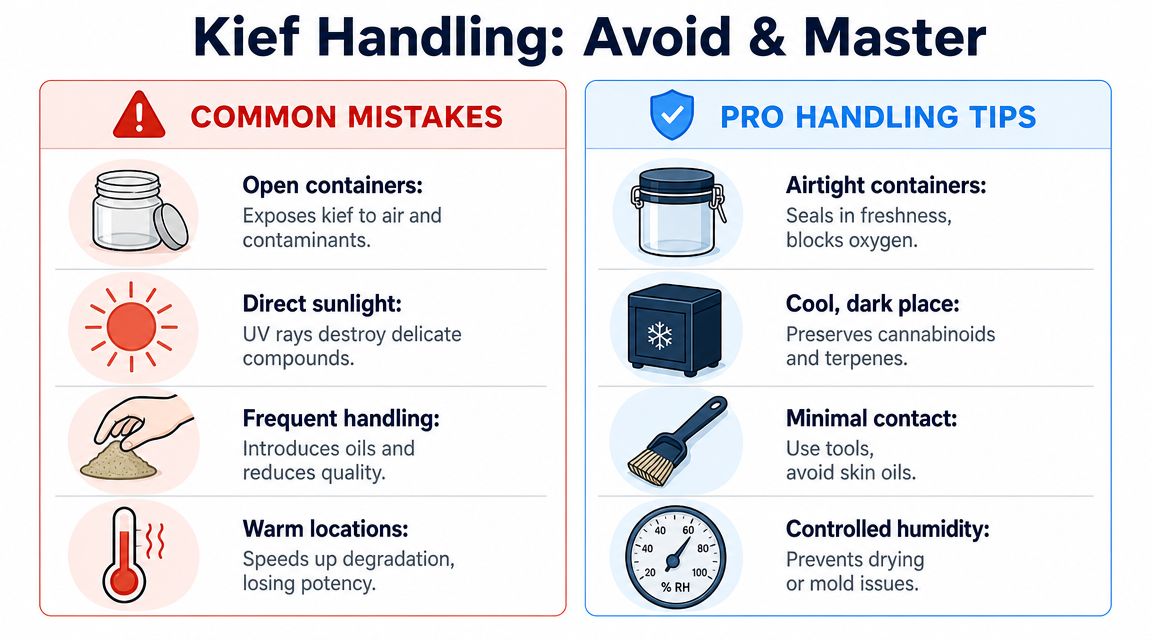
- Using the fridge: The environment changes too often.
- Keeping it in plastic baggies: Static and weak sealing are a bad combination.
- Handling it with fingers: Skin oils and moisture don't belong in your stash.
- Opening the jar too often: Every opening refreshes the air inside.
- Storing near heat sources: Cabinets by ovens, radiators, and sunny windows all cause trouble.
One common problem gets overlooked. People often store kief in whatever container they already have, instead of the container that fits the material. That shortcut usually means too much air, too much light, or both.
Better handling habits
The pros keep it boring and clean.
Use a small metal tool, a silicone scoop, or another dedicated implement that won't leave residue behind. Work over a tray, a clean piece of parchment, or a smooth glass surface so any spill is easy to recover. Keep your active amount separate from your reserve.
A dedicated tool does more than keep things tidy. It helps preserve texture, cleanliness, and consistency.
If your preferred consumption method is vapor rather than combustion, it also helps to understand how different devices treat concentrates and infused material. This overview of Strong Strains cannabis vapes gives useful context on format choice and handling.
Good accessories make storage easier
The right accessory setup reduces waste before storage even starts.
A grinder with a solid kief catcher helps you collect clean material. A proper jar helps you preserve it. Clean scoops, parchment, a compact tray, a Glass Pipe for topping bowls, Raw Paper for infused joints, or a device from PUFFCO all support cleaner use when it's time to enjoy it.
That doesn't mean buying more gear than you need. It means matching your tools to your habits so you stop losing kief to static, spills, and sloppy handling.
Your Kief Storage Questions Answered
A few questions always come up once people have the basics down.
How can you tell if kief has gone bad
Start with your senses.
Fresh kief should still smell expressive, not flat or musty. If it looks unusually dark, shows odd discoloration, or has clumped in a way that suggests moisture got in, treat that as a warning sign. A stale smell is one thing. A suspicious smell is another.
If mold is a concern, err on the side of caution and don't use it.
How long can kief stay potent
There isn't one universal expiration date.
Storage quality decides the answer. A carefully sealed stash kept away from light, air, heat, and moisture will hold quality much better than material left in a grinder or opened constantly. If you want to preserve it, focus less on “how long” and more on how consistently you control the environment.
Can you use a humidity pack with kief
Yes, and many people do, especially for a longer-held stash.
The key is using a cannabis-safe humidity pack and keeping the overall setup airtight and stable. Humidity control can help prevent the texture from drifting too dry or too damp, but it doesn't rescue bad storage habits. If your jar lives in a hot, bright, or humid room, the pack won't fix the bigger problem.
What's the easiest way to press stored kief into hash
Keep it simple.
Use a small amount, clean parchment, and gentle pressure. The goal is to bind the material into a tidier form, not overwork it. People often complicate this step, but for personal use, a clean and controlled approach is better than improvising with too much heat.
Is kief better for smoking, vaping, or infusing
That depends on how you want it to behave.
For topping flower, kief adds intensity and flavor quickly. For vaporizing, careful loading matters because loose material can make a mess in the wrong device. For infusions, decarboxylation and dosing matter more than storage convenience. If you're exploring measured cannabis formats beyond flower and concentrates, products like THC tincture 1000 mg are worth understanding as a separate category with a very different use case.
The best method is the one that matches your tolerance, routine, and gear.
Strong Strains is East Setauket's premium cannabis dispensary for Long Island adults 21+ who want better flower, concentrates, accessories, and guidance that helps. If you're building a top-shelf stash and want lab-tested products, smart recommendations, and reliable pickup or local delivery, explore Strong Strains.